Criticality Analysis
Asset prioritization and business impact assessment.
3 Practice Areas
Business-Impact and Dependency Mapping
Asset Classification and Ownership
Risk Prioritization and Validation
Helping organizations enhance their ability to anticipate, withstand, recover from, and adapt to adverse cyber events. Its primary goal is to provide a structured approach for assessing an organization's current cyber resilience maturity and identifying priority areas for improvement.
The Cyber Resilience Capability Maturity Model (CR-CMM) was developed through comprehensive research in cybersecurity maturity assessment methodologies. Our research team analyzed existing maturity models, industry best practices, and real-world implementation challenges to create a practical, evidence-based framework for cybersecurity capability assessment.
Unlike traditional compliance-focused approaches, CR-CMM emphasizes research-backed, sustainable processes that evolve with organizational needs and the changing threat landscape.
CR-CMM is the community-driven cyber resilience capability maturity model, guided by an Advisory Board for technical integrity and strategic input. CR-CMM is sponsored and owned by High Value Target, a boutique cyber resilience firm.
CR-CMM is structured into ten practices, each containing three focus areas. This structure helps accelerate the completion of the assessment questionnaire and supports the effective identification and prioritization of improvement opportunities.
Asset prioritization and business impact assessment.
Threat landscape monitoring and intelligence.
Intelligence-driven security controls.
Security-by-design system architecture.
Incident response and crisis coordination.
Realistic cyber attack simulations.
Backup and recovery validation.
Security control validation.
Red team and penetration testing.
Post-incident recovery operations.

A note from
Francesco Chiarini
Founder, High Value Target
Achieving true cyber resilience requires a structured, measurable approach and accountable leadership to continuously driving the awareness and improvement of a cyber resilient posture. Like Zero Trust, cyber resilience is an overused term that means different things to different players - whether in industry or among regulators. This lack of clarity makes it harder to define what true cyber resilience capabilities are, and to choose the right set and scale of capabilities for an organization.
An organization's cyber resilience efforts primarily aim to implement strategies and tactics that ensure the survivability of mission-critical functions before, during, or after a coordinated, destructive cyber-attack. Such cyber resilience strategies and tactics require capabilities to address the continuously evolving risks from advanced and unpredictable adversaries.
The Cyber Resilience Capability Maturity Model (CR-CMM) helps organizations measure, benchmark, and enhance their resilience across ten key domains. The CR-CMM is a community-driven practical tool inspired by the famous SOC-CMM and aligned with NIST SP 800-160, the MITRE Cyber Resiliency Engineering Framework, and other best-in-class frameworks (such as ORF, Sheltered Harbor, CTI-CMM). While being sector- and size-agnostic, the CR-CMM aligns with industry best practices and draws from widely recognized frameworks maintained by organizations such as NIST and MITRE.
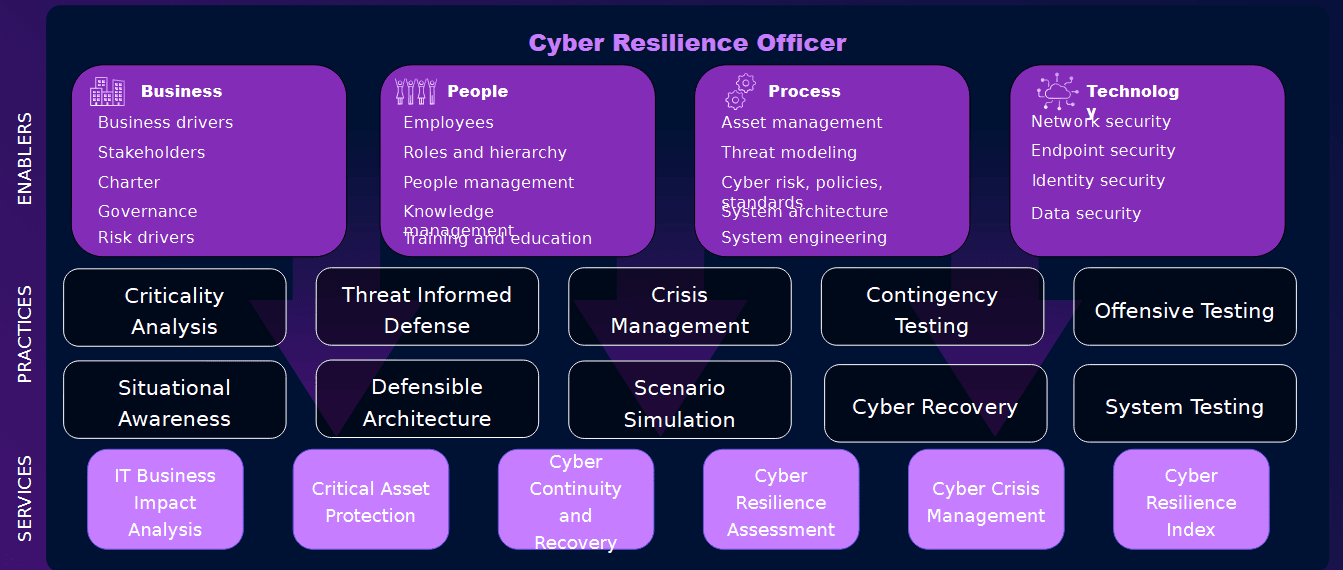
The maturity levels range from initial (where resilience practices are reactive and uncoordinated) to optimized (where resilience is proactive, integrated into all aspects of system design, and supported by continuous improvement). It's important to note that the CR-CMM is not yet another "standard" or "framework". It's a toolkit. It consolidates that spectrum by leveraging world-class best practice and shows how to achieve cyber resilience with 150+ evidence-based questions and their related maturity scoring. The model is structured around four key enabling domains that mirror those used in the SOC-CMM: Technology, Process, People, and Business, but adapted to emphasize cyber resilience Services. There are ten core Practices that are leveraged to build capabilities, which are visible in the slide below. These sit at the heart of the CR-CMM.
Essential insights for leadership teams evaluating cyber resilience capabilities.
Essential insights for leadership teams evaluating cyber resilience capabilities.